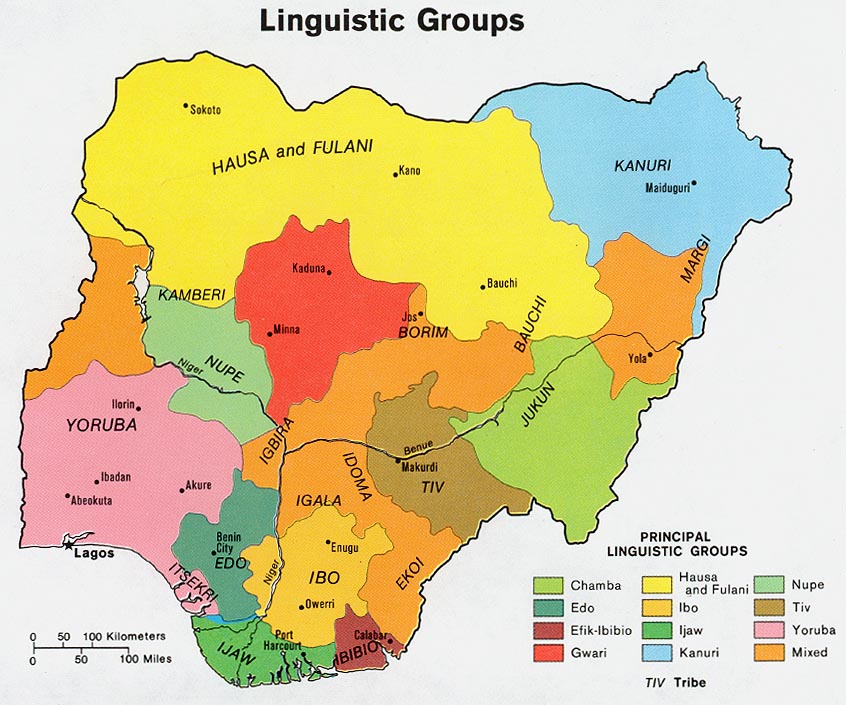
The Kwah — also known as the Ba, Bakoa, or Qua — are a small indigenous people group living in the savannah river valleys of northeastern Nigeria. Their two principal towns, Gyakan and Kwa, are located near Munga in the Lamurda and Numan Local Government Areas of Adamawa State, with related communities extending into the Karim-Lamido Local Government Area of Taraba State. The Benue River lies nearby, and its tributaries and valleys have shaped the geography and livelihood of the communities for generations.
The Kwah speak Kwa, a Niger-Congo language widely considered one of the most linguistically unusual tongues in Nigeria. Linguists who have studied it describe it as increasingly divergent — difficult to place within any single established language family, and significant enough that it has been treated as its own independent branch. Kwa speakers call themselves the Báà and their language nyaa Báà. The two main communities differ somewhat in pronunciation but share the same essential tongue. The Kwa language's written form is not well established, though a Bible translation is underway and audio Scripture resources are available.
The region where the Kwah live has been shaped by centuries of diverse ethnic and religious influence. The Adamawa Emirate, rooted in the Fulani jihad of the early nineteenth century, brought Islam into the broader region, and neighboring peoples have practiced both Islam and traditional religion alongside the Kwah for generations. Despite these wider movements of history, the Kwah have maintained their distinct identity, language, and spiritual practices.
The Kwah are primarily subsistence farmers, as are most communities in Adamawa State's river valleys. The fertile soil near the Benue corridor supports crops including yam, cassava, maize, millet, guinea corn, and groundnuts, with some families also engaging in fishing from the nearby rivers. Trade in local markets connects the Kwah to neighboring peoples including the Bata, Jenjo, and Fulani, and the town of Numan — a trading and administrative hub not far away — offers access to goods and services beyond the village economy.
Family life is organized around extended households, and communal relationships within the two principal towns carry significant social weight. Elders hold authority in matters of land, marriage, and community governance. Marriage customs reinforce kinship ties between families, and decisions of importance are rarely made without broad family counsel. Community celebrations, including those tied to the harvest cycle and significant life events, bring the towns together and sustain a shared sense of belonging.
Life in Adamawa State has been affected in recent years by the broader insecurity of Nigeria's northeast, including displacement caused by the Boko Haram insurgency in nearby areas. While Numan LGA has not been the conflict's primary zone, the wider context of uncertainty touches economic conditions and community stability throughout the region.
Traditional ethnic religion is the primary belief system of the majority of the Kwah. Their religious worldview is rooted in animism — the belief that spiritual forces inhabit the natural and human world — and centers on two principal traditional deities: Gbandima and Kassimin. Communal rituals, offerings, and observances tied to these spiritual figures and to ancestor veneration have been part of Kwah life for generations. These practices provide a framework for understanding the world, addressing illness, seeking blessing for the harvest, and marking the passages of life.
A minority of the Kwah have embraced Christianity, and a smaller portion practice Islam, reflecting the influence of neighboring peoples and the wider religious landscape of Adamawa State. The Evangelical believers among the Kwah — those who hold to personal faith in Jesus Christ and the authority of Scripture — are present but represent a modest portion of the community. A Bible translation in Kwa is in progress, and audio teachings are available, but the majority of the community has not yet encountered the life-changing message of the gospel.
Greater access to healthcare, education, and reliable infrastructure would make a tangible and lasting difference for Kwah families, who live in a region where these resources remain limited. The ongoing completion and distribution of Scripture in the Kwa language is an urgent spiritual priority — God's Word in the heart language of the Kwah is essential for planting and sustaining genuine faith. Pastoral support and discipleship resources are needed for the Evangelical believers already present, so that a church with deep roots and growing maturity can be established among the Kwah. Those Kwah believers who have come to faith in Christ are in a unique position: with the gospel now present in their community, they can become the primary witnesses to their own people — and eventually to others around them who also lack a gospel witness.
Pray for the completion of Scripture translation in the Kwa language and for audio resources to reach those who cannot read, so that the Kwah may encounter God's Word in their own tongue.
Pray that the Holy Spirit will move powerfully among the Kwah, drawing many from traditional religion and other practices to saving faith in Jesus Christ.
Pray for the evangelical believers among the Kwah to grow in maturity and boldness, and to carry the gospel to neighboring peoples in Adamawa and Taraba States who have even less access to Christ.
Pray for peace, physical safety, and practical development for Kwah communities — for access to healthcare, schools, and economic stability that allows families to flourish.
Scripture Prayers for the Kwah in Nigeria.
https://en.wikipedia.org/wiki/ISO_639:kwb
https://en.wikipedia.org/wiki/Adamawa_State
https://en.wikipedia.org/wiki/Adamawa_languages
https://zodml.org/discover-nigeria/states/adamawa-state
https://globalrecordings.net/en/language/kwb
https://www.ethnologue.com/language/kwb/
| Profile Source: Joshua Project |